Heavy duty document scanners are essential tools for businesses managing large volumes of paperwork, transforming physical documents into organized digital assets. These scanners boost productivity, streamline workflows, and ensure compliance by processing thousands of pages daily with unwavering reliability and speed. They are critical for sectors like finance, legal, government, and healthcare, where digitizing documents is a core operational task.
Understanding Heavy Duty Document Scanners
Heavy duty document scanners are engineered for immense daily workloads, reliably processing tens of thousands, and sometimes hundreds of thousands, of pages. Unlike standard office scanners, these machines feature robust components and advanced capabilities for continuous, high-volume operation with minimal downtime. They are indispensable workhorses for environments with constant paper flow, where digitization is a primary operational requirement.
The main advantage of a heavy duty scanner is a significant increase in productivity. By automating manual scanning, businesses free up employee time for strategic tasks. These scanners enhance document management, providing quick access to digital files, improving data security, and supporting regulatory compliance through searchable, organized archives. They reduce physical storage needs, fostering a more efficient and eco-friendly office. For see our document scanners recommendations on this site.
Key Features to Look for in Heavy Duty Document Scanners
Selecting the right heavy duty document scanner requires evaluating several critical features that determine its performance, efficiency, and suitability for your specific high-volume needs.
Speed and Daily Duty Cycle
For heavy duty applications, speed is crucial. Scanners are measured in pages per minute (PPM) for single-sided documents and images per minute (IPM) for duplex (double-sided) scanning. High-volume scanners typically start at 50 PPM and can exceed 150 PPM, with IPM figures often doubling the PPM. The daily duty cycle is an equally vital metric, indicating the maximum pages a scanner can reliably process per day without accelerated wear. For heavy duty models, this ranges from 30,000 to over 100,000 pages per day, with some top-tier production scanners offering “no daily limit.” Aligning these figures with your organization’s actual and projected scanning volume is essential to prevent bottlenecks and premature equipment failure.
Automatic Document Feeder (ADF) Capacity and Reliability
An Automatic Document Feeder (ADF) is indispensable for high-volume scanning, enabling batch processing without constant manual intervention. Heavy duty scanners feature large ADF capacities, typically starting at 100 sheets and extending to 500, 750, or even 2,000 sheets in high-end production models. A robust ADF ensures continuous feeding of mixed document stacks, significantly reducing operator involvement. Look for models that allow for continuous feeding, where you can add documents to the feeder while scanning is in progress, maximizing throughput.
Advanced Paper Handling (Duplex, Mixed Batches, Protection)
|
Our Picks for the Best Document Scanner in 2026
As an Amazon Associate I earn from qualifying purchases.
|
||
| Num | Product | Action |
|---|---|---|
| 1 | Epson WorkForce ES-50 Portable Sheet-Fed Document Scanner for PC and Mac |

|
| 2 | Brother DS-640 Compact Mobile Document Scanner, (Model: DS640) 1.5"x2"x11.9" |
|
| 3 | ScanSnap iX2500 Wireless or USB High-Speed Cloud Enabled Document, Photo & Receipt Scanner with Large 5" Touchscreen and 100 Page Auto Document Feeder for Mac or PC, White |
|
| 4 | ScanSnap iX1300 Compact Wireless or USB Double-Sided Color Document, Photo & Receipt Scanner with Auto Document Feeder and Manual Feeder for Mac or PC, White |
|
| 5 | Canon imageFORMULA R10 - Portable Document Scanner, USB Powered, Duplex Scanning, Document Feeder, Easy Setup, Convenient, Perfect for Mobile Users |
|
| 6 | Epson Workforce ES-C220 Compact Desktop Document Scanner with 2-Sided Scanning and Auto Feeder (ADF) for PC as Well as Mac |
|
| 7 | ScanSnap iX1300 Compact Wireless or USB Double-Sided Color Document, Photo & Receipt Scanner with Auto Document Feeder and Manual Feeder for Mac or PC, Black |
|
| 8 | ScanSnap iX2500 Wireless or USB High-Speed Cloud Enabled Document, Photo & Receipt Scanner with Large 5" Touchscreen and 100 Page Auto Document Feeder for Mac or PC, Black |
|
| 9 | Doxie Pro DX400 - Duplex Document Scanner and Receipt Scanner For Home and Office With Amazing Software for Mac and PC |
|
| 10 | Canon imageFORMULA R40 Office Document Scanner Receipt Edition, for PC and Mac, Scan & Extract Data to QuickBooks Online, Color Duplex Scanning, Auto Document Feeder, Easy Setup for Office Or Home Use |
|
Superior paper handling is a hallmark of heavy duty scanners. Single-pass duplex scanning is standard, capturing both sides of a document in one pass, effectively doubling efficiency. These scanners handle mixed batches containing various document types, sizes, and thicknesses—from fragile receipts and plastic ID cards to legal-sized papers and thick file folders—without laborious pre-sorting. Features like automatic skew correction ensure straight scans, while ultrasonic multi-feed detection prevents multiple pages from feeding simultaneously, reducing rescans and potential damage. Furthermore, Intelligent Document Protection or similar technologies can detect staples or paper clips and halt scanning to prevent physical damage to both the document and the scanner.
Image Quality and Enhancement (DPI, OCR, Barcode Reading)
While speed is important, clear and accurate digital images are the ultimate goal. For general text-heavy documents, 200-300 DPI (dots per inch) is often sufficient. However, for documents with fine print, detailed graphics, or images, 600 DPI or higher ensures optimal clarity. Many heavy duty scanners include advanced image enhancement features such as Perfect Page technology (Kodak Alaris) or Clear Image Capture (Ricoh/Fujitsu). These technologies automatically enhance image quality, remove blank pages, improve text legibility, and correct common scanning imperfections. Optical Character Recognition (OCR) is vital, converting scanned images into editable, searchable text, indispensable for document management systems and efficient information retrieval. Barcode reading capabilities can also automate document indexing and routing.
Connectivity and Software Integration
Modern heavy duty scanners offer versatile connectivity options, including USB, Wi-Fi, and Ethernet, allowing flexible deployment and shared network access. TWAIN and ISIS drivers ensure broad compatibility with various document imaging applications and enterprise content management (ECM) systems. Bundled software often provides features like scan-to-cloud, scan-to-email, scan-to-network folder, and custom profiles for different scanning tasks, enhancing workflow automation. An intuitive control panel, often a large color touchscreen, simplifies operations for users, even non-technical staff.
Durability and Maintenance
Given intense workloads, heavy duty scanners are built with rugged materials for longevity. Look for models with a strong reputation for durability and easily replaceable consumables like rollers. Ease of maintenance, including simple cleaning procedures and readily available spare parts, is crucial to minimize downtime. Many manufacturers offer comprehensive service contracts for these mission-critical devices.
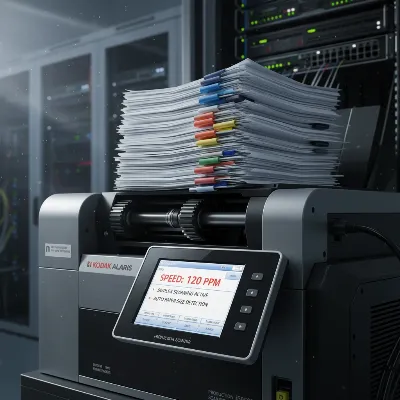 A heavy-duty document scanner with a large ADF and a clear touchscreen, highlighting key features like speed, paper handling, and digital integration.
Types of Document Scanners for High Volume Environments
Heavy duty document scanners primarily fall into two categories: production scanners and departmental scanners.
Production Scanners
These are the titans of the scanning world, purpose-built for the most demanding, highest-volume environments where document processing is continuous and mission-critical. Production scanners offer the fastest speeds (often 100-150+ PPM), the largest ADF capacities (500-2,000 sheets), and the highest daily duty cycles (100,000+ pages). They feature advanced paper handling to ensure virtually uninterrupted scanning of mixed media, including delicate, oversized, or extremely thick documents. These scanners are typically found in large corporate scanning centers, government archives, business process outsourcing (BPO) operations, and other facilities requiring unparalleled throughput and durability. Examples include the Kodak Alaris i5000 series (e.g., i5250, i5650) and Ricoh/Fujitsu fi-7800, fi-7900, and fi-8950 models.
Departmental Scanners
Departmental scanners bridge the gap between desktop models and full-blown production units. They are designed for busy departments within larger organizations or for medium-sized businesses with significant, but not extreme, daily scanning needs. These scanners typically offer speeds ranging from 50-100 PPM, ADF capacities of 100-300 sheets, and daily duty cycles from 10,000 to 50,000 pages. They provide many advanced features found in production scanners, such as duplex scanning, advanced image processing, and robust paper handling, but in a more compact and often desktop-friendly footprint. The Kodak Alaris i3000 and i4000 series, Ricoh/Fujitsu fi-8150, and some Xerox W-series models fit this category, offering a balance of performance, features, and cost for environments like busy law firms, medical offices, or accounting departments.
While flatbed scanners are excellent for fragile or bound documents, their slower speed makes them unsuitable for bulk scanning. Some heavy duty ADF scanners do come with an integrated or optional flatbed unit, offering versatility for scanning irregular items alongside high-volume batches.
Top Heavy Duty Document Scanners for High Volume Use
Based on industry reputation, performance metrics, and user reviews, several models consistently stand out for their heavy duty capabilities.
- Kodak Alaris i5000 Series (e.g., i5250, i5650): Renowned for their “no daily limit” duty cycle, these production scanners offer exceptional speed (up to 150-210 PPM) and robust paper handling for huge batch jobs. Their Perfect Page technology delivers superior image quality, and they come with large input feeders up to 750 sheets. The S5180 is another ultra-rugged model for mission-critical environments.
- Ricoh/Fujitsu fi-8950 / fi-7900 / fi-7800: These production scanners are built for speed and durability, with the fi-8950 reaching 150 PPM (300 IPM duplex) and a 750-sheet ADF, and the fi-7900 handling up to 140 PPM (280 IPM duplex) with a daily duty cycle of 120,000 pages. They excel in centralized scanning environments, offering robust paper protection and advanced image processing features like Clear Image Capture.
- Xerox W110 / W130: Designed for high-speed production, the Xerox W110 offers speeds up to 120 PPM (240 IPM) and a daily duty cycle of 100,000 pages, with a 500-page adjustable input tray. The W130 is even faster at 135 PPM (270 IPM). These scanners include powerful image processing and reliable paper feeding mechanisms, making them suitable for intensive scanning tasks.
- Epson WorkForce DS-32000: While many heavy duty scanners focus on A4, the DS-32000 is an A3 document scanner, ideal for environments that frequently handle oversized documents. It offers fast speeds (up to 90 PPM / 180 IPM) and a 120-sheet ADF, making it a versatile option for mixed media scanning in larger formats.
- HiPro 8×1 Production Scanner: This powerhouse is designed for extreme production environments, with models offering 160, 220, and even up to 300 PPM. Key features include a dual input tray with a 2,000-sheet capacity, a straight paper path for thick media, and innovative paper guides for damage protection.
Choosing the Right Heavy Duty Document Scanner for Your Business
Selecting the ideal heavy duty scanner involves a strategic assessment of your specific operational needs and long-term goals.
Assessing Your Specific Needs
Begin by quantifying your daily or weekly scanning volume. How many documents do you process? What types of documents are they (standard paper, mixed sizes, fragile, thick cards)? What is the typical condition of these documents (stapled, creased, mixed)? Understanding these variables will guide your search towards scanners with appropriate speed, ADF capacity, and paper handling capabilities. Consider your primary usage: is it for archiving historical records, day-to-day transaction processing, or specialized tasks like invoice automation?
Evaluating Performance Metrics
Focus on the key performance indicators: PPM/IPM, daily duty cycle, and ADF capacity. A higher duty cycle indicates greater durability and longevity under strenuous use. Ensure the ADF can reliably handle the variety and condition of your typical document batches. Don’t overlook features like multi-feed detection and automatic image enhancement, which significantly impact efficiency and the quality of your digital output.
Considering Software Ecosystem and Integration
A scanner is only as good as its integration into your existing digital ecosystem. Verify compatibility with your operating systems, document management systems (DMS), and cloud storage platforms. Robust TWAIN/ISIS drivers are crucial for seamless integration with third-party software. Consider whether advanced features like integrated OCR, barcode reading, and customizable scan profiles are essential for automating your workflows.
Long-Term Investment: Durability and Support
Heavy duty scanners represent a significant investment. Prioritize models from reputable manufacturers known for their build quality and reliable performance. Investigate warranty options, readily available spare parts, and the quality of technical support. Easy maintenance and quick service response can minimize downtime and ensure your scanning operations remain uninterrupted.
“A well-chosen heavy duty document scanner can be a major upgrade, transforming stacks of paper into accessible digital assets, significantly cutting costs, and boosting overall operational agility for any organization.” – Michael Chen, Data Management Consultant.
Maximizing Efficiency: Tips for Using and Maintaining Your Heavy Duty Scanner
To get the most out of your heavy duty document scanner, proper usage and diligent maintenance are key.
Best Practices for Scanning Large Batches
- Prepare Documents: Though heavy duty scanners handle mixed batches well, a quick pre-scan check for staples, paper clips, or excessively torn pages can prevent jams and damage. Fanning stacks slightly can also improve feeding reliability.
- Utilize ADF Fully: Load the ADF to its maximum capacity when possible to minimize interruptions and maximize continuous scanning.
- Optimize Settings: Use the lowest acceptable DPI for text documents (200-300 DPI) to achieve faster scanning speeds and smaller file sizes. Reserve higher resolutions for images or documents requiring exceptional detail.
- Leverage Software Features: Configure scan profiles for different document types to automate settings like color mode, duplexing, and destination folders. Utilize OCR to create searchable PDFs from the outset.
Regular Cleaning and Maintenance Schedule
Regular cleaning is crucial for maintaining optimal performance and extending the lifespan of your scanner. Dust and paper residue can build up on rollers and glass, leading to misfeeds and poor image quality.
- Daily/Weekly: For high-volume environments, clean feed rollers and glass guides weekly, or even daily, using recommended cleaning supplies.
- Monthly/Quarterly: Inspect and clean separation pads and other internal components.
- Replace Consumables: Adhere to the manufacturer’s recommendations for replacing feed rollers and separation pads, which are wear-and-tear items critical for reliable paper feeding.
Troubleshooting Common Issues
While heavy duty scanners are robust, minor issues can arise.
- Paper Jams: Most modern scanners have intelligent jam detection. If a jam occurs, follow the on-screen instructions carefully to clear it, always opening covers slowly and removing paper in the direction of the feed.
- Image Quality Issues: Streaks or lines often indicate dirt on the scanner’s glass. Clean thoroughly. Blurry images might mean an incorrect DPI setting or a need for software recalibration.
- Multi-Feeds: If the scanner is picking up multiple pages, clean or replace the separation rollers and pads. Ensure documents are fanned and not sticking together.
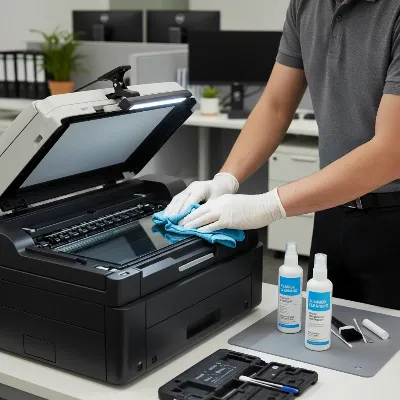 A person cleaning the feed rollers of a heavy-duty document scanner with a cleaning solution and cloth, emphasizing careful maintenance.
Conclusion
For businesses handling substantial daily volumes of documents, investing in a heavy duty document scanner is not merely an expense but a strategic imperative. These powerful machines deliver unparalleled speed, reliability, and advanced paper handling, transforming chaotic paper trails into streamlined digital workflows. By carefully considering features such as daily duty cycle, ADF capacity, advanced image processing, and robust build quality, organizations can select a scanner that meets their precise needs, enhances productivity, and fortifies their document management strategy. Whether you’re digitizing historical archives or processing daily transactions, the right heavy duty scanner can provide the efficiency and peace of mind you need to thrive in a digital-first world. What is the most critical feature your business looks for in a high-volume scanning solution?
Frequently Asked Questions
What is the difference between a high-volume and a standard scanner?
High-volume scanners are designed for continuous, intense use, processing tens of thousands to hundreds of thousands of pages daily with speeds often exceeding 100 PPM. Standard scanners are for lighter, intermittent use, typically handling hundreds to a few thousand pages per day at slower speeds.
What does “daily duty cycle” mean?
The daily duty cycle is the manufacturer’s recommendation for the maximum number of pages a scanner can process in a 24-hour period without risking premature wear or failure. For heavy duty models, this figure is typically very high, indicating their robust design.
How important is OCR for high-volume scanning?
OCR (Optical Character Recognition) is highly important for high-volume scanning as it converts scanned images into searchable and editable text. This functionality is crucial for efficient document retrieval, integration with document management systems, and automating data extraction from digitized records.
Can heavy-duty scanners handle mixed document types?
Yes, a key advantage of heavy-duty scanners is their advanced paper handling capabilities, allowing them to reliably process mixed batches of documents, including various sizes, weights, and even fragile or plastic cards, often without the need for pre-sorting.
What resolution is best for archiving business documents?
For most business documents, a resolution of 200-300 DPI (dots per inch) is sufficient for clear text and efficient file sizes, especially when combined with OCR. Higher resolutions, like 600 DPI, are usually reserved for documents with detailed graphics or high-quality images.
Choosing the Right Heavy Duty Document Scanner
Selecting an ideal heavy duty document scanner involves assessing your specific operational needs, evaluating performance metrics, considering software integration, and prioritizing durability for a long-term investment.
Quantify your daily or weekly scanning volume and identify the types of documents you process (e.g., standard paper, mixed sizes, fragile, thick cards). Understanding these variables will guide your search towards scanners with appropriate speed, ADF capacity, and paper handling capabilities. Consider your primary usage, such as archiving historical records or day-to-day transaction processing.
Focus on key performance indicators like PPM/IPM, daily duty cycle, and ADF capacity. A higher duty cycle indicates greater durability and longevity under strenuous use. Ensure the ADF can reliably handle the variety and condition of your typical document batches, and don't overlook features like multi-feed detection and automatic image enhancement.
Verify compatibility with your operating systems, document management systems (DMS), and cloud storage platforms. Robust TWAIN/ISIS drivers are crucial for seamless integration with third-party software. Determine if advanced features like integrated OCR, barcode reading, and customizable scan profiles are essential for automating your workflows.
Heavy duty scanners are a significant investment, so prioritize models from reputable manufacturers known for build quality and reliable performance. Investigate warranty options, readily available spare parts, and the quality of technical support. Easy maintenance and quick service response minimize downtime and ensure uninterrupted scanning operations.
Get our weekly buyer guide
Practical specs, not advice. Unsubscribe anytime.

We recently upgraded to a heavy-duty scanner for our legal firm, and it’s been a game-changer. The ability to process thousands of pages daily without a hitch has drastically cut down on our administrative time. It’s truly an indispensable workhorse, especially with all the client files we handle. Highly recommend for any office with a constant paper flow.
We use this for government document archiving, and it’s holding up great under immense daily workloads. The continuous, high-volume operation is exactly what we were looking for. My only minor gripe is that the footprint is quite large, so make sure you have dedicated space for it. Otherwise, it’s a solid investment for serious digitization.
I got one of these for our small healthcare practice, hoping to streamline our patient records. While it does handle large volumes well, I found the initial setup a bit more complicated than I expected. The software integration with our existing system took some extra effort. It’s good, but be prepared for a learning curve if you’re not tech-savvy.
Our finance department needed something robust to keep up with all the incoming invoices and statements. This heavy-duty scanner has been perfect. The reliability and speed are exactly what we needed to transform our physical documents into organized digital assets. It’s made a huge difference in our daily operations and compliance efforts.